
OSHA 10, 30 or 40-Hour Training: Which Course Do You Need?
Written by Staff Writer | Edited by Michael Purser

A worker completes OSHA 30, earns their card and starts a new job. Then they are told they need another 40 hours of Hazardous Waste Operations and Emergency Response (HAZWOPER) training before they can begin certain assignments. Why is that? Haven’t they done enough coursework?
It might seem redundant, but there's a good reason for it. Workplace safety requirements aren't based on how many hours someone has spent in a classroom; they're based on the work being performed and the hazards involved.
That's an important difference when comparing Outreach and HAZWOPER training programs. These aren't three levels of the same system, and completing one doesn't automatically satisfy the requirements of another.
Here's what separates all three and how to determine which training you actually need.
Training Programs Compared
Although these courses all address workplace safety, they have different purposes, intended audiences and training requirements.
- OSHA 10: A 10-hour course primarily intended for entry-level workers. It introduces common workplace hazards and basic safety practices.
- OSHA 30: A more extensive, 30-hour course intended for supervisors and workers with safety responsibilities. It provides broader coverage of workplace hazards but doesn't cover the instruction needed for specialized tasks.
- HAZWOPER: A 40-hour course for workers involved in certain hazardous waste operations. It addresses hazardous substance exposure and requires additional supervised field experience for applicable roles, along with annual refresher training.
Here’s how they compare side by side:
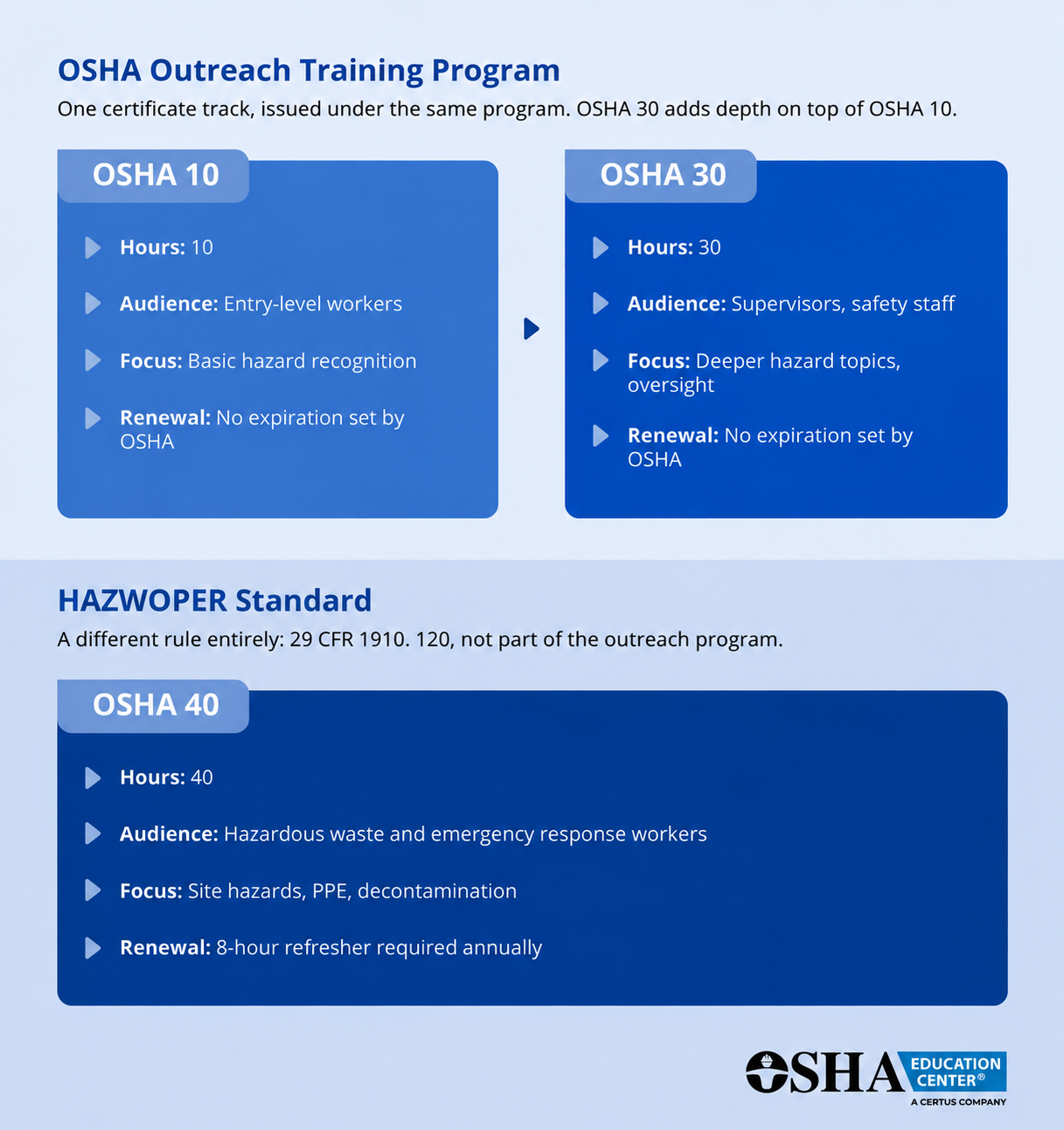
These programs aren't interchangeable, and more training hours don't automatically mean you've met every requirement for every role. For example, OSHA 30 may satisfy an employer's OSHA 10 requirement, but that isn't always guaranteed.
Additionally, neither Outreach course replaces the specialized training required for certain hazardous waste operations.
What Do Outreach Training Programs Qualify You For?
The 10-hour and 30-hour programs are part of OSHA’s official Outreach Training Program. The administration offers versions for professionals in both construction and general industry, with topics tailored to the hazards workers are most likely to encounter. The variations are equivalent, but not identical.
Workers who complete an OSHA-authorized program earn an official card from the U.S. Department of Labor (DOL) to document their achievement. But there's an important limitation that sometimes gets overlooked: An OSHA card only documents completed training. It doesn't certify that someone is qualified to perform every task that the course covers.
For example, a worker who completes OSHA 30-Hour for Construction may learn about confined-space hazards. That doesn't automatically qualify them to enter permit-required confined spaces.
The same principle applies to other regulated activities. Employers remain responsible for providing any additional instruction required by applicable safety standards.
Outreach training isn’t required at the federal level, even if it is strongly encouraged. But it is required by many individual employers and local jurisdictions as a baseline for safety education.
What Is HAZWOPER Training?
You may have heard HAZWOPER referred to as OSHA 40 or 40-hour OSHA training, but those terms aren't technically correct. Unlike OSHA 10 and OSHA 30, this isn't part of the federal Outreach Training Program operated by OSHA and the DOL and is not related to those courses. The DOL doesn’t offer an OSHA 40 card.
Outreach Training courses are general safety awareness programs that are useful for almost every job, no matter the industry. HAZWOPER deals exclusively with protocols for handling substances that present a danger to personal or environmental health.
Under 29 CFR 1910.120, general site workers who may be exposed to hazardous substances during covered cleanup operations must receive at least 40 hours of initial instruction and three days of supervised field experience before working with regulated substances on a qualifying jobsite.
Think about a heavy equipment operator who has spent years working on traditional construction sites. If they move to a covered hazardous waste cleanup project, their existing safety education may not satisfy the additional requirements or adequately prepare them for the dangers posed by hazardous materials.
The appropriate instruction depends on the operation, their assigned duties, and potential exposure. In general, if your job requires you to mitigate, manage or respond to uncontrolled releases of regulated substances, you need HAZWOPER training.
What About New York City's 40-Hour SST Requirement?
New York City has its own 40-hour program, unrelated to HAZMAT operations.
Construction workers in NYC must obtain a Site Safety Training (SST) Worker card to set foot on almost all major construction sites in the five boroughs. One qualifying pathway combines OSHA 30 Construction with 10 additional hours of approved instruction, including Fall Prevention and Mental Health Awareness.
NYC SST exclusively deals with local construction site safety requirements established by the city's Department of Buildings and does not have a major HAZMAT component.
How Do You Know Which Safety Training You Need?
Before enrolling in a program, find out exactly what your job entails. Confirm with your employer which federal regulations, local rules or company policies apply. You should also confirm whether the course must cover a particular industry or prepare you for specific tasks.
Don’t make assumptions based on your title. Two environmental technicians, for example, might have very different assignments. One could collect samples during routine site assessments, while another may participate directly in hazardous waste removal. In this case, their exposure risks and training requirements differ substantially.
Never assume that completing a longer course automatically satisfies a shorter course requirement. If you're moving into a new role, check whether your existing credentials still apply.
The longest course isn't necessarily the right one. And one may not be enough. Your employer must ensure you receive all the training needed to address the hazards and responsibilities associated with your work.