
The Most Lucrative Jobs in Construction
Written by Tanya Gonzalez | Edited by Michael Purser

The construction industry is known for providing stable work and advancement opportunities. However, many people don’t realize just how fruitful a career in this field can be.
While entry-level roles may start modestly, earning potential rises sharply as workers gain skills, certifications or experience — even without a college degree.
Salaries vary depending on location, expertise, certification and task complexity. However, that variability is what makes this field attractive for those willing to learn a trade or take on more responsibility.
Whether you’re fresh to the industry, trying to grow professionally or simply want to gain a new skill set, this guide will help you choose the career path that best aligns with your goals.
Read on to learn more about the top-paying roles, what they entail, the skills that are required for each and how you can maximize your earnings.
How We Ranked These Roles
To determine which professions offer the greatest long-term earning potential, we examined the following:
- Compensation Range: We looked at average (base) wages reported by the U.S. Bureau of Labor Statistics (BLS) and the potential for overtime, bonuses or union pay — both nationally and in high-cost-of-living states or metropolitan areas.
- Skill and Experience Requirements: Positions that require advanced technical skills, specialized equipment operation or extended apprenticeships offer better compensation.
- Certification and Training Load: Roles requiring licensure or formal certification (as opposed to on-site learning) were given greater weight.
- Demand and Future Growth: We considered available labor supplies, maintenance demand and industry trends (e.g., renewable energy, industrial expansion). We also provide a sample progression of job titles.
While individual opportunities can vary, taking these factors into consideration can help you choose the right role and maximize your earning potential.
The Highest-Paying Construction Jobs
Some industry roles offer higher initial income and better opportunities for growth than others. Here’s a closer look at 20 of the industry’s top-paying titles, the qualifications required and how to land them.
1. Elevator & Escalator Installer/Repairer
- Median Salary: $106,500
- Typical Range: $80,000 to $135,000
- Responsibilities: Install, maintain, troubleshoot and modernize elevators and/or escalators as well as perform safety inspections.
- Required Skills/Training: Usually a four-to-five-year apprenticeship, strong mechanical and electrical skills and rigorous safety training.
- Career Path/Growth: Apprentice to journeyman to lead mechanic to supervisor/inspector.
- Major Factors: High technical complexity, strict safety standards and a limited supply of licensed techs.
2. Construction Manager/Project Manager
- Median Salary: $102,000
- Typical Range: $75,000 to $150,000
- Responsibilities: Oversee entire projects, including budgeting, scheduling, monitoring subcontractors and performing quality control/compliance reviews.
- Required Skills/Training: Previous experience in construction and/or project management; OSHA 30 training or a degree.
- Career Path/Growth: Assistant PM to PM to senior PM to director or general contractor.
- Major Factors: High responsibility and direct impact on cost, schedule and safety.
3. Civil Engineer (Construction-Focused)
- Median Salary: $95,000
- Typical Range: $70,000 to $130,000
- Responsibilities: Design and oversee infrastructure developments (roads, bridges, drainage, foundations, etc.).
- Required Skills/Training: A bachelor’s degree or a project engineer license for advanced roles.
- Career Path/Growth: Engineer in Training (EIT) to project engineer to senior engineer to engineering manager.
- Major Factors: Technical expertise, legal liability and project-critical decision-making skills.
4. Boilermaker
- Median Salary: $73,300
- Typical Range: $60,000 to $100,000
- Responsibilities: Install and repair boilers, tanks and pressure vessels; welding and heavy industrial work.
- Required Skills/Training: Apprenticeship, welding certifications and/or rigging skills.
- Career Path/Growth: Apprentice to journeyman to lead boilermaker to industrial foreman.
- Major Factors: Working in high-risk industrial environments and having specialized welding skills.
5. Industrial Electrician
- Median Salary: $77,000
- Typical Range: $60,000 to $105,000
- Responsibilities: Install and maintain electrical systems for factories, plants and industrial equipment.
- Required Skills/Training: Apprenticeship and licensing; high-voltage safety and code controls knowledge.
- Career Path/Growth: Journeyman to master to industrial maintenance lead.
- Major Factors: Technical, hazardous work with continuous demand.
6. Commercial Electrician
- Median Salary: $72,500
- Typical Range: $55,000 to $95,000
- Responsibilities: Install and maintain building wiring, lighting, panels and electrical systems and mitigate hazards.
- Required Skills/Training: Apprenticeship and licensing; code knowledge.
- Career Path/Growth: Apprentice to journeyman to master to electrical contractor.
- Major Factors: Essential trade with ongoing building and renovation demand.
7. Crane Operator/Heavy Equipment Operator (Advanced)
- Median Salary: $80,700
- Typical Range: $60,000 to $105,000
- Responsibilities: Operate cranes and heavy lift equipment, work with rigging teams and ensure safe material placement.
- Required Skills/Training: Certification, equipment-specific training and strong safety awareness.
- Career Path/Growth: Operator to lead operator to lift planner to equipment supervisor.
- Major Factors: High legal liability, specialized qualifications and an overall skill shortage.
8. Ironworker/Steelworker
- Median Salary: $62,700
- Typical Range: $50,000 to $95,000
- Responsibilities: Construct steel frameworks, weld, rivet and work on high structural elements.
- Required Skills/Training: Apprenticeship, welding/rigging skills and fall-protection training.
- Career Path/Growth: Journeyman to foreman to superintendent to structural specialist.
- Major Factors: Physically demanding labor, subject to higher-than-average fall risks and industry demand for highly skilled metalworkers.
9. Plumber/Pipefitter/Steamfitter
- Median Salary: $73,000
- Typical Range: $55,000 to $100,000
- Responsibilities: Install and maintain water, gas, steam and industrial piping systems.
- Required Skills/Training: Apprenticeship, licensing, welding or advanced pipefitting skills.
- Career Path/Growth: Apprentice to journeyman to master to contractor or industrial lead.
- Major Factors: High demand for servicing essential infrastructure, strict licensing requirements and complex installations.
10. Sheet-Metal Worker
- Median Salary: $58,400
- Typical Range: $45,000 to $80,000
- Responsibilities: Fabricate and install ductwork, metal panels and Heating, Ventilation and Air Conditioning (HVAC) components.
- Required Skills/Training: Apprenticeship, metal fabrication and HVAC system knowledge.
- Career Path/Growth: Journeyman to lead technician to HVAC/sheet-metal supervisor.
- Major Factors: Precision fabrication and HVAC integration skills.
11. HVAC Technician (Industrial)
- Median Salary: $65,000
- Typical Range: $55,000 to $95,000
- Responsibilities: Install and maintain large-scale industrial HVAC and refrigeration systems.
- Required Skills/Training: Technical certification, Heating, Ventilation, Air Conditioning and Refrigeration systems (HVAC/R) training and U.S. Environmental Protection Agency (EPA) licensing.
- Career Path/Growth: Tech to senior tech to industrial HVAC specialist.
- Major Factors: High technical skill and demand in manufacturing, data centers and plants.
12. HVAC Technician (Commercial)
- Median Salary: $55,000
- Typical Range: $45,000 to $80,000
- Responsibilities: Install/repair commercial heating, cooling and ventilation systems.
- Required Skills/Training: HVAC certification and troubleshooting skills.
- Career Path/Growth: Tech to lead tech to commercial HVAC supervisor.
- Major Factors: Year-round demand and technical troubleshooting.
13. Construction/Building Inspector
- Median Salary: $70,000
- Typical Range: $55,000 to $90,000
- Responsibilities: Inspect work for code compliance, safety and quality.
- Required Skills/Training: Licensing/certification and broad knowledge of codes and trades.
- Career Path/Growth: Inspector to senior inspector to quality/safety manager.
- Major Factors: High responsibility and regulatory oversight.
14. Project Estimator/Cost Engineer
- Median Salary: $75,000
- Typical Range: $60,000 to $110,000
- Responsibilities: Create cost estimates and evaluate materials, labor, timelines and bids.
- Required Skills/Training: Construction knowledge, math/analysis skills and estimating software expertise.
- Career Path/Growth: Junior estimator to senior estimator to chief estimator.
- Major Factors: Accuracy determines project profitability.
15. General Contractor (Independent)
- Median Salary: $122,500+
- Typical Range: $45,000 to $200,000+
- Responsibilities: Manage client projects, hire subcontractors and oversee budgets/schedules.
- Required Skills/Training: Licensing, trade knowledge and business management acumen.
- Career Path/Growth: General contractor, to multi-crew contractor to company owner.
- Major Factors: Earnings are tied to project volume and business scale. The more work you take on, the more you’ll make.
16. Foreman/Crew Leader
- Median Salary: $68,000
- Typical Range: $55,000 to $90,000
- Responsibilities: Lead crews, coordinate tasks, enforce safety and meet deadlines.
- Required Skills/Training: Trade experience, leadership skills and jobsite coordination.
- Career Path/Growth: Skilled worker to foreman to superintendent.
- Major Factors: Leadership responsibility and productivity impact.
17. Carpenter
- Median Salary: $56,000
- Typical Range: $45,000 to $80,000
- Responsibilities: Completing build framing, formwork, walls, trim and structural wood components.
- Required Skills/Training: Apprenticeship or experience, carpentry skills and tool proficiency and often an OSHA 10 safety card.
- Career Path/Growth: Journeyman to lead carpenter to foreman to contractor.
- Major Factors: Core skills are essential for nearly all building and renovation projects.
18. Masonry Worker (Brick/Block/Stone/Concrete)
- Median Salary: $56,600
- Typical Range: $45,000 to $80,000
- Responsibilities: Lay brick and stone; pour and finish concrete; build structural and decorative masonry.
- Required Skills/Training: On-the-job or apprenticeship training and mastery of masonry techniques.
- Career Path/Growth: Journeyman to masonry foreman to specialty masonry contractor.
- Major Factors: Skilled craftsmanship and demanding physical labor.
19. Rigger
- Median Salary: $72,000
- Typical Range: $55,000 to $100,000
- Responsibilities: Set rigging for heavy loads, secure materials and coordinate with crane operators.
- Required Skills/Training: Rigging certification, safety training and load-calculation knowledge.
- Career Path/Growth: Rigger to senior rigger to lift supervisor.
- Major Factors: High-risk and specialized heavy-lift expertise.
20. Taper/Drywall Finisher
- Median Salary: $54,000
- Typical Range: $45,000 to $75,000
- Responsibilities: Tape, mud, sand and finish drywall to create paint-ready surfaces.
- Required Skills/Training: On-the-job training and precision finishing ability.
- Career Path/Growth: Finisher to lead finisher to interior finishes supervisor.
- Major Factors: Precision is crucial for the final project’s overall aesthetics while also maintaining functionality.
Factors That Influence Pay
There’s no “one size fits all” number when it comes to construction industry salaries. Your projected income will depend heavily on the task’s complexity level, your degree of expertise and where you live (or where the project is located) — to name a few. These are some of the most common variables:
Location and Cost of Living Differences
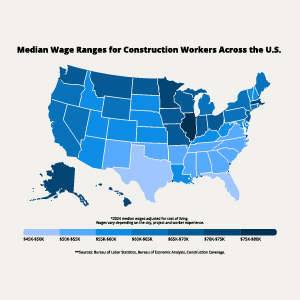
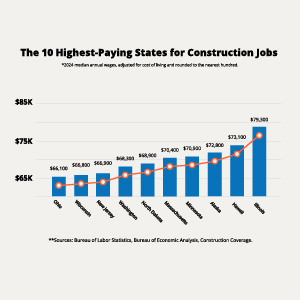
The area you work in significantly affects your rates. Some states pay substantially more due to the higher cost of living, union presence or heavy demand for skilled labor. For example, states like Illinois, Hawaii, Alaska, Massachusetts, Washington and several Northeast and West Coast states consistently report some of the highest median wages for construction workers.
By contrast, Southern states or rural areas often pay lower hourly rates, which can mean large discrepancies in annual income between two workers with the same title. If you wish to make more than the average salary in your state, you may consider relocating (or targeting certain markets) to increase your earning potential.
Before you commit to a role or change zip codes, research regional pay data and the cost of living. A “good wage” in one state may be modest in another.
Union vs. Non-Union Roles
Union membership often comes with higher base wages, structured pay scales, overtime guarantees, better benefits and negotiated contracts that protect workers. Many of the most profitable positions (crane operators, elevator installers, ironworkers, heavy-equipment operators, etc.) are heavily unionized.
Non-union roles might offer flexibility, but unions offer more stability, predictable raises and long-term job security — particularly in large markets or for commercial projects.
Experience and Education Level
As in any field, skill and experience influence your salary. Entry-level positions offer less, while seasoned journeymen, supervisors or craft foremen are among the top earners.
Investing in a training program or apprenticeships pays off in the long term — especially in trades requiring technical knowledge or equipment handling.
Specialized Skills or Certifications
Skills such as welding, crane operation, high-voltage electrical systems, instrumentation and safety management all elevate wages.
Certifications, licenses and experience handling specialized tasks make you a more attractive candidate and can lead to significantly better paychecks.
Project Type (Residential vs. Commercial/Industrial vs. Infrastructure)
The more complex the task, the greater the rewards. Commercial projects, like those involving industrial facilities, infrastructure improvements, high-rise buildings and renewable energy installations, are more lucrative than standard residential work.
Employers will favor those with advanced skills, certifications, safety compliance and efficient project execution for these roles. Plus, large commercial jobs tend to run longer and include overtime, boosting overall compensation.
Career Paths and Tips for Advancement
You can progress from a minimum-wage, entry-level position to one that offers a top-tier salary faster than you think. Below are a few tips that can speed up your career journey.
Begin with an Apprenticeship
Many top-paying roles begin with an apprenticeship — a paid training program that combines classroom work with on-the-job experience. That path builds foundational skills without incurring student debt. It also helps you advance your career faster, leading to more lucrative opportunities.
Get Certified and Keep Learning
Certifications and licenses broaden your opportunities. Many employers reward certification with bigger paychecks, better job security and priority assignment to complex projects. Customers also prefer certified workers, since certification provides them with peace of mind knowing that the project will be completed by a trained and experienced professional.
Join a Union or Trade Organization
As previously mentioned, union membership offers structured wage scales, benefits and access to high-quality jobs, especially on commercial or infrastructure projects. Trade organizations also offer training, networking and mentorship — all of which help you advance in your career track.
Gain Cross-Trade or Management Skills
Learn to read blueprints, practice basic project management or gain supervisory experience. Many of the best-paid project managers and forepersons began their careers as tradespeople. Getting comfortable with scheduling, budgets and team coordination opens the door to management roles with endless earning potential.
Specialize in High-Demand, High-Skill Roles
Advanced skills or niche positions, such as an elevator installer or repairman, crane operator or industrial electrician, are always in high demand — especially as infrastructure ages, renewable energy expands and commercial construction grows. Specializing in a particular area now can lead to exponential income growth for years to come.
Safety, Risks and Job Satisfaction
Labor-intensive trades are not for the faint of heart. However, many workers find that the benefits far outweigh the potential hazards. It's essential to carefully evaluate the pros and cons from every angle. This way, you can decide whether a role is right for you.
Some factors to consider include:
Physical and Mental Demands
Most construction jobs are physically demanding — even those that require certification or a higher level of education. They often involve heavy lifting, operating complex machinery and exposure to harsh weather or industrial environments.
They also don't tend to follow typical nine-to-five schedules. This means workers must stay sharp at all times and be prepared to work long hours or take extra shifts.
Project duration can also shift, often due to permit setbacks, labor shortages, sizing miscalculations or other complications. Workers should always approach a project with an open mind and a general understanding that plans may change.
Balancing Risk vs. Reward
Naturally, the roles that offer the most competitive rates in this field usually require greater knowledge, responsibility and training. However, this often means that the safety risk will also increase. Many workers accept the trade-off because the pay, benefits and long-term stability outweigh them.
While the potential for sustaining injuries is omnipresent, safety training, personal protective equipment (PPE) and strict OSHA protocols help mitigate the hazards. That being said, it’s up to each individual to follow the rules and be mindful of possible dangers.
Regardless of experience level, the more you know about your role, the materials and tools you’ll be using, the general project scope and best practices, the more likely you’ll be to succeed while keeping yourself and others safe.
Finding a Sense of Purpose
For many, working in construction provides tangible rewards: seeing buildings finished, systems completed, bridges finished and infrastructure renewed. That sense of accomplishment, plus the ability to earn effectively without a traditional four-year degree, can lead to long-term job satisfaction.
Skilled tradespeople often enjoy their hands-on work, autonomy, respect for craftsmanship and steady demand — especially when they've built strong reputations in their field. In an industry where ingenuity and vigilance are key, having these unique talents sets you apart.
Tying It All Together
Construction remains one of the most promising and profitable industries for skilled workers. Whether you aim to be an electrician wiring a factory, a crane operator lifting steel beams high above a city skyline or a project manager coordinating large developments, the opportunities are there and yours for the taking.
The most sought-after positions demand expertise, dedication, training and a willingness to work hard at physically and technically challenging tasks. But for those who commit, the financial rewards, career stability and personal satisfaction are definitely worthwhile.