
What are Telehandlers and Forklifts with Telescopic Booms?
Written by Staff Writer
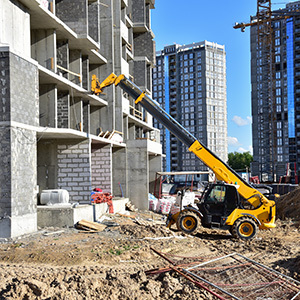
A telehandler is a rough-terrain lift truck with a telescopic boom. It can lift like a forklift, reach like a boom and place loads in spots that would otherwise require repositioning the machine.
That extra reach is also where risk sneaks in. As the boom extends and deflects, the machine’s stability changes fast, and the “safe load” can drop in a way that surprises even experienced crews.
This guide explains what a telehandler is, where it fits in real work, how it differs from a standard forklift and what safe operation actually looks like, even when schedules are tight and the site is busy.
Telehandler Definition and Features
A telehandler, also called a telescopic handler or telescopic forklift, is a rough-terrain lift truck with a boom that extends outward and upward. It can pick and place materials in spots that are awkward for a conventional mast-style forklift, especially on uneven ground, which is why it’s treated as serious industrial machinery on busy sites.
On many sites, it ends up acting like a Swiss Army machine. With the right attachments, it can move pallets, place trusses, carry pipe, scoop loose material or lift a work platform when allowed by the manufacturer and the job plan. Common features include:
- A telescoping boom that changes load capacity as it extends
- Multiple steering modes such as front-wheel, four-wheel and crab steering
- Outriggers or stabilizers on some models for specific lifts
- Quick-attach systems for forks, buckets, jibs, truss booms and other attachments
- A load chart that must be followed based on boom angle, extension and attachment
That load chart is the difference between a controlled lift and a tip-over, especially when the boom is stretched forward.
Where Telescopic Handlers Excel
Telehandlers are most common on construction sites, yards and outdoor industrial areas where industrial machinery is expected to move heavy materials while changing terrain. They thrive where ground conditions change, space is limited or material has to be placed at height.
A few everyday scenarios show why crews rely on them
- Setting pallets near a wall without driving into the work zone
- Placing bundles of lumber onto a second-story deck from outside the footprint
- Moving pipe or long materials where a standard forklift would struggle to balance
- Feeding materials to roofers or framers while keeping traffic lanes open
They can save time when the lift is planned correctly and the machines are properly maintained. They can also create a chain-reaction incident when the site treats them like just another forklift.
How a Telehandler Differs from a Standard Forklift Truck
From a distance, forks are forks. In practice, these machines behave differently, and the differences matter most when conditions are imperfect.
A conventional forklift is usually built for stable surfaces and vertical lifting. A telehandler is built for reach, uneven terrain and variable capacity across a much wider working envelope.
That means the risk profile changes. Boom extension shifts the center of gravity forward, and the same load that feels fine at a short reach can become unsafe when the boom is extended another few feet.
Five Smart Operating Practices
Most operators already know the basics. The difference is whether the site supports safe habits when the pressure rises.
These practices show up on well-run sites again and again:
- Keeping the load low while traveling and avoiding turns on slopes
- Using a spotter in tight zones, blind corners or backing routes
- Planning the placement zone before lifting loads, not while holding them
- Avoiding sudden boom movements that can bounce or swing a suspended load
- Respecting the load chart every time, especially when reaching forward
Using a Telehandler Like an Aerial Work Platform
Some jobs use telehandlers with a work platform to lift workers. This is allowed only under strict conditions, and it should never be improvised.
OSHA treats this as a high-risk activity. If people are lifted, the telehandler and platform must be designed and approved for that use.
At a minimum, follow the manufacturer’s instructions and ensure the setup meets OSHA’s requirements for lifting personnel, including:
- A safety platform firmly secured to the lifting carriage
- A way for personnel on the platform to shut off power to the truck
- Protection from falling objects when conditions indicate it’s needed
- Only use a platform and configuration approved by the manufacturer for lifting personnel (no improvising)
If any of those pieces are missing, the task should stop. Ask yourself: Is this job better suited for an aerial lift designed to raise people?
If crews want more clarity on telehandler use cases, training and common rule questions, the telehandler FAQs page is a helpful starting point.
How to Choose the Right Training Path for the Jobsite
A telehandler is often one piece of lifting equipment in a bigger safety puzzle. Many employers pair equipment training with broader, OSHA-authorized Outreach training so workers understand hazard recognition, control basics and what to do when something feels off.
OSHA Education Center offers OSHA-authorized Outreach training through the University of South Florida, including OSHA 10-hour and OSHA 30-hour options for construction and general industry.
For operators and employers who need telehandler-focused learning, the telehandler training course is built for real-world use, and it fits a busy schedule because it’s online and self-paced.
For teams managing multiple lift truck types, the types of forklifts guide can help safety leads match tasks to equipment, instead of forcing one machine to do everything.
Certificates, Cards and Workforce Proof for Operating High-Capacity Trucks
Employers need documentation, and workers need proof they can show when a supervisor or safety manager asks. OSHA Education Center’s training is designed to make that part easier.
After completion, workers can access proof of training quickly, which helps reduce delays when a crew needs to get moving. Are you ready to advance your career and help keep worksites safe?
For operators who want a clear, job-ready option, the guide on getting a forklift driver card explains what proof typically looks like and how workers can keep it accessible.
For anyone unsure about eligibility basics, the minimum age to be a forklift operator resource clarifies the rules and common employer requirements.
Start with the Next Right Step
Telehandlers are valuable because they do hard jobs efficiently. They also demand respect because reach and rough terrain can create potentially dangerous situations.
Remember, workers who need telehandler training that’s practical, clear and built around compliance expectations can begin with OSHA Education Center’s PIT certification training and telescopic handler training course for a direct path forward. Start today