
How OSHA Holds Employers Accountable: The Biggest Workplace Safety Penalties by State
Written by Staff Writer | Edited by Joey Rosenberg

A construction trench caves in on a worker below. A machine starts while a worker is clearing a jam on top of it. A chemical spill sends cleanup workers in without adequate training or proper equipment.
These are not abstractions.
They are the documented events behind some of the largest OSHA penalties in recent memory. The largest OSHA fines, identified in 15 states, ranged from $285,000 to $4.7 million between 2024 and 2026.
Unfortunately, there are many cases where a worker paid with their life before any fine was issued.
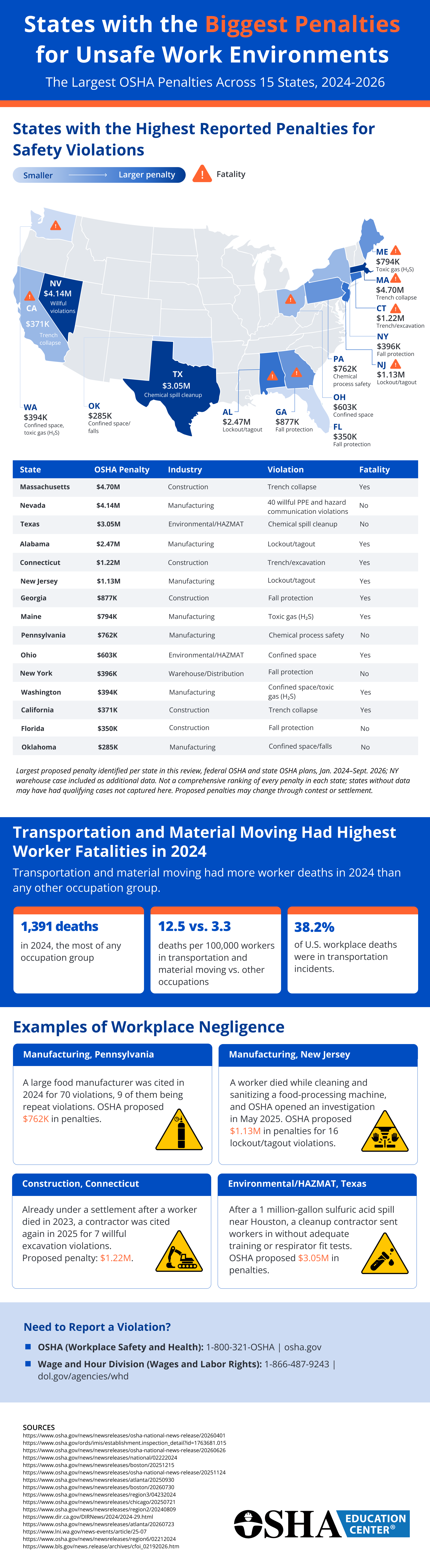
This map demonstrates the largest workplace safety penalties in fifteen states between January 2024 and September 2026. The map shows the largest penalties identified in this review, not every penalty issued in each state.
The data draws on federal and state OSHA enforcement data across primarily high-hazard industries (construction, manufacturing and environmental/HAZMAT work). Altogether, the data reveals the priciest violations, which industries incur the heaviest fines and why the citation value only tells part of the story.
Key Takeaways
- At $4.7 million, the largest penalty was in Massachusetts among the 15 states shown.
- The manufacturing industry accounts for seven of the 15 penalties listed on the map, the most of any industry.
- Lockout/tagout (LOTO) failures generated major penalties in two states, Alabama ($2.47M) and New Jersey ($1.13M).
- The largest fines don’t track where workers die most: 1,391 workers in transportation and material moving died in 2024, roughly four times the rate of other occupations.
Note: Every figure reflects a proposed penalty, which can change if the employer contests the citations or settles.
How Are Penalties Calculated?
OSHA's penalty calculation weighs severity, the employer's history and whether violations were willful. A willful violation means the employer knew the hazard existed and chose to ignore it.
Twelve of the 15 largest penalties on the map involved willful violations, with five of them (Massachusetts, Alabama, New Jersey, Florida and Washington) also including repeat violations. Nevada’s $4.14 million penalty covered 56 violations at a single manufacturing site, 40 of them willful. Connecticut’s $1.22 million penalty came from a follow-up inspection of a contractor who was already under a settlement after a worker died in 2023.
The violation category also matters. LOTO, trench safety and confined space entry draw especially severe penalties because failures in each one are almost always life-threatening, and OSHA’s penalty structure reflects that.
Violation Type | States with Violations | # of Cases with a Life Lost | Largest Penalty Identified |
Trench/Excavation Collapse | Massachusetts, Connecticut, California | 2 of 3 | $4.70M (MA) |
LOTO | Alabama, New Jersey | 2 of 2 | $2.47M (AL) |
Fall Protection | Georgia, New York, Florida | 1 of 3 | $877K (GA) |
Confined Space | Ohio, Oklahoma, Washington | 2 of 3 | $603K (OH) |
Chemical/HAZMAT Exposure | Texas, Pennsylvania, Maine | 1 of 3 | $3.05M (TX) |
PPE and Hazard Communication | Nevada | 0 of 1 | $4.14M (NV) |
Note: Connecticut’s cited inspection did not involve a death. The contractor was already under a settlement agreement after a worker died in a separate 2023 trench collapse at another site. The Texas figure is the penalty proposed against the cleanup subcontractor. OSHA proposed $3.52 million in total across the three employers involved in the Houston-area spill response.
Which Industries Have the Most Penalties
Manufacturing accounts for 7 of the 15 state penalties on the map, the most of any industry. Furthermore, manufacturing holds two of the four largest fines on the map: Nevada and Alabama, both stacked with willful violations.
Construction cases account for 5 of the 15 listed, the second-highest volume of penalties. Every construction case reflected in the data involves a violation category that OSHA has flagged for decades: trenching and excavation or fall protection.
Environmental and HAZMAT work accounts for two cases in Texas and Ohio. In both states, workers were sent into known hazard zones without required safeguards. The remaining case is a New York warehouse cited for failing to correct fall hazards that OSHA first identified in 2021.
Disclaimers on the Data
Every dollar figure on the map is a proposed penalty. Proposed amounts can change if the employer contests the citations or reaches a settlement with OSHA. Nevada's $4.14 million case, for example, remains open and contested.
Geographic coverage is also a constraint. This dataset captures the largest penalty identified for 15 states across primarily high-hazard industries. It does not establish each state’s maximum penalty. A state without an entry may still have had qualifying cases that this review did not capture.
Also, penalty price does not directly correlate with hazard severity. Pennsylvania’s $762,000 penalty covered 70 violations, many tied to its chemical process safety program, with no reported injury. California’s smaller $371,000 fine was due to a trench collapse that resulted in death. Larger fines often reflect higher counts of violations rather than a single catastrophic event.
Penalties also don’t show where the most workers die. The largest OSHA fines track documented site violations, and the occupational group with the most on-the-job deaths is barely represented on the map. According to the Bureau of Labor Statistics, 1,391 workers in transportation and material moving died in 2024, a fatal injury rate roughly four times that of all workers.
What Workers and Employers Can Do with This Information
Employers carry the responsibility for keeping workplaces safe: providing equipment, fixing known hazards and giving workers safety information they can understand. Training doesn't replace any of that, but it does help workers and supervisors spot hazards before they cause illness or injury.
For employees in factories, warehouses, salons, processing plants and other general industry settings, OSHA Education Center offers a variety of courses to promote workplace safety, including OSHA 10-hour training classes and online 30-hour safety training. Workplaces handling hazardous materials can also take advantage of our HAZWOPER training options. With the right training, workers and employers can make work sites safer.
Frequently Asked Questions
What is the largest OSHA penalty proposed in this dataset?
Massachusetts has the highest figure in this dataset: a proposed OSHA penalty of $4,699,362, issued in 2026, tied to a late-2025 trench collapse in which a worker died. That makes it the largest single proposed penalty among all 15 states covered here. The case included 7 willful violations and 33 repeat violations.
What types of violations appear the most?
Trenching and excavation, fall protection, LOTO and confined space entry are the violation types that recur across the largest penalties in this dataset. LOTO failures alone generated major proposed penalties in two states, $2.47 million in Alabama and $1.13 million in New Jersey. A worker died in both cases.
How can I report an unsafe workplace to OSHA?
Workers can call OSHA directly at 1-800-321-OSHA or visit osha.gov to file a complaint. For wage and labor rights violations, the Wage and Hour Division can be reached at 1-866-487-9243 or at dol.gov/agencies/whd. OSHA accepts complaints by phone, online or in writing, and employees have the right to request confidentiality.
About OSHA Education Center: Since 2012, OSHA Education Center has provided online safety and compliance training for workers and employers. Its offerings include OSHA-authorized 10- and 30-hour Outreach courses through the University of South Florida, HAZWOPER training and other industry-specific programs.
Sources:
Occupational Safety and Health Administration. (2026, April 1). US Department of Labor cites construction contractor with 7 willful, 33 repeat violations after fatal Yarmouth cave-in. Retrieved from https://www.osha.gov/news/newsreleases/osha-national-news-release/20260401
Occupational Safety and Health Administration. (n.d.). Inspection Detail: 1763681.015 - Daehan Solution Nevada, LLC. Retrieved from https://www.osha.gov/ords/imis/establishment.inspection_detail?id=1763681.015
Occupational Safety and Health Administration. (2026, June 26). US Department of Labor proposes $3.5M in fines for dangerous health, safety violations by 3 employers during Houston facility chemical spill response. Retrieved from https://www.osha.gov/news/newsreleases/osha-national-news-release/20260626
Occupational Safety and Health Administration. (2024, February 22). US Department of Labor proposes nearly $2.5 million in penalties for Alabama sawmill, finds willful disregard for safety led to fatality. Retrieved from https://www.osha.gov/news/newsreleases/national/02222024
Occupational Safety and Health Administration. (2025, December 15). US Department of Labor cites Connecticut earthwork contractor for continued violations after follow-up inspection, proposes $1.2M fine. Retrieved from https://www.osha.gov/news/newsreleases/boston/20251215
Occupational Safety and Health Administration. (2025, November 24). US Department of Labor proposes more than $1M fine following worker fatality at New Jersey vegetable processing facility. Retrieved from https://www.osha.gov/news/newsreleases/osha-national-news-release/20251124
Occupational Safety and Health Administration. (2025, September 30). US Labor Department issues more than $900,000 in penalties to 2 companies after worker drowns in Georgia river. Retrieved from https://www.osha.gov/news/newsreleases/atlanta/20250930
Occupational Safety and Health Administration. (2026, July 30). US Department of Labor cites Maine hardwood pulp mill more than $700K for exposing workers to chemical hazards. Retrieved from https://www.osha.gov/news/newsreleases/boston/20260730
Occupational Safety and Health Administration. (2024, April 23). Department of Labor again cites Hanover Foods for exposing workers to dozens of safety, health hazards; proposes $761K in penalties. Retrieved from https://www.osha.gov/news/newsreleases/region3/04232024
Occupational Safety and Health Administration. (2025, July 21). Federal investigators cite waste management company for failure to implement confined space entry requirements resulting in worker fatality. Retrieved from https://www.osha.gov/news/newsreleases/chicago/20250721
Occupational Safety and Health Administration. (2024, August 9). Adidas America faces nearly $400K in penalties for uncorrected, recurring fall hazards found in 2021 at Orange County, New York, warehouse. Retrieved from https://www.osha.gov/news/newsreleases/region2/20240809
California Department of Industrial Relations. (2024, April 18). Cal/OSHA Cites Construction Company $371,100 for Safety Violations that Led to Fatal Trench Collapse in San Francisco. Retrieved from https://www.dir.ca.gov/DIRNews/2024/2024-29.html
Occupational Safety and Health Administration. (2026, July 23). Federal investigators cite Florida roofing contractor for willfully, repeatedly ignoring fall protection standards, propose $349K in fines. Retrieved from https://www.osha.gov/news/newsreleases/atlanta/20260723
Washington State Department of Labor & Industries. (2025, February 26). Fertilizer manufacturer fined nearly $400,000 following worker death from toxic gas. Retrieved from https://www.lni.wa.gov/news-events/article/25-07
Occupational Safety and Health Administration. (2024, February 21). US Department of Labor finds Oklahoma aeronautical parts manufacturer exposed workers to numerous serious safety hazards. Retrieved from https://www.osha.gov/news/newsreleases/region6/02212024
U.S. Bureau of Labor Statistics. (2026, February 19). National Census of Fatal Occupational Injuries in 2024. Retrieved from https://www.bls.gov/news.release/archives/cfoi_02192026.htm